Looking at this year’s Asian Games lineup, a standout observation is just how lopsided the ratio of world-class Filipino achievers is to the Philippines’ overall population. Within just the sample of tennis players led by world 18th-ranked star Alex Eala, one couldn’t be blamed for thinking that this looks sort of like a typical Philippine basketball team where an import or two accounts for a disproportionate share of what contributes to the success or failure of the overall team.
When one considers that it ultimately came down to two Chinese nationals competing for the gold, it becomes easy to appreciate why Eala single-handedly carried so much of an entire nation’s mental health on her shoulders and why the collapse of her bid to deliver on that hope stung so much.
Filipinos continue an unhealthy habit of riding the coattails of an infinitesimally small cohort of elite individuals amongst them and burdening them with their “pride” and “hopes”.
| SUPPORT INDEPENDENT SOCIAL COMMENTARY! Subscribe to our Substack community GRP Insider to receive by email our in-depth free weekly newsletter. Subscribe to our Substack newsletter, GRP Insider! Learn more |
And that is not Alex Eala’s problem.
The trouble with Filipinos is they have an unproductive relationship with “luck”. They look at a rich or successful person and they think ang swerte naman nito (this person is so lucky). People like Eala are the very definition of outliers. In this case, an extreme one. She is at the very end of a long-tailed bell curve that describes Filipino achievement.
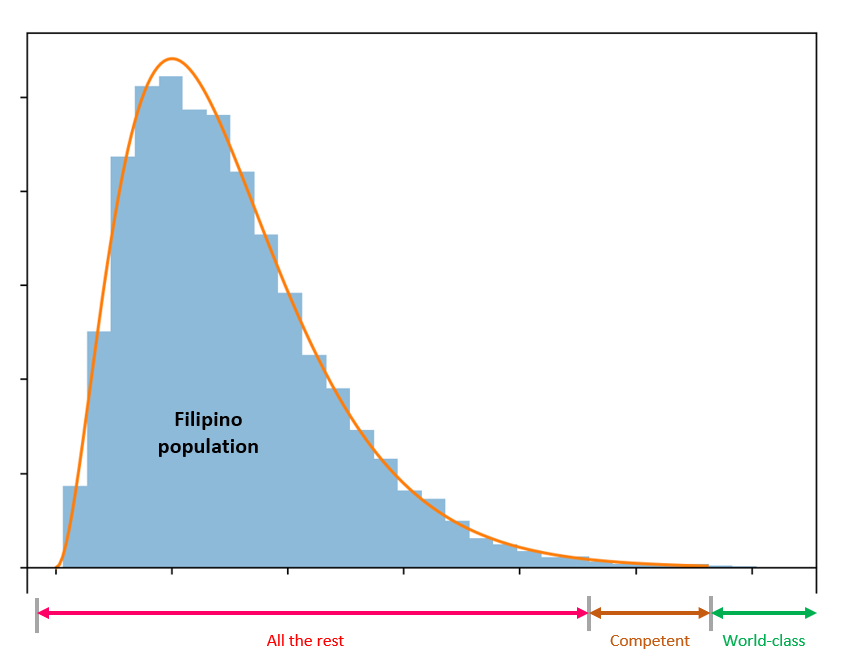
The above hypothetical diagram likely describes two things at the same time: (1) the probability of a Filipino becoming “world class” through hard work, persistence, and talent and (2) the current composition of the Philippines’ population over the same scale. This is also the probability distribution describing your chances of becoming world-class rich by betting on the lotto. It is easy to see here that the tiny minority of world-class Filipinos (even including the merely competent members of society) utterly lack the weight to pull the national average even slightly to the right side of this equation.
Now juxtapose the above mathematical concept with Eala’s fantasy of representing the Filipino nation in her chosen life endeavour and you get a clear analogue of what is going on here — starker perhaps but still consistent with the arithmetic described by the above diagram.

Urban legend has it that, following her catastrophic defeat to Wang Xiyu in the Asian Games tennis singles semi-final, Eala turned to her dad tearfully asking “what am I doing wrong?”
If we want to apply a clinical answer to such a heart-wrenching question (one every dad dreads hearing from a heart-broken child), there is only one obvious one. Cut yourself loose. And to Eala’s fans, perhaps allow the words of that famous modern-day philosopher Sting to resonate loudly: If you love someone, set them free. Alex Eala’s chosen profession is to be a world-class tennis player. Our job is to be tennis fans; not obstacles to Eala’s goal.
If we want the Philippines to part of the global tennis map — in the way truly world-class tennis nations are — Filipinos should unhitch that mountain off Eala’s back and work on moving that mountain themselves. Collectively.

- What is Alex Eala doing wrong? For starters she’s pulling Pinoy Pride along with her in an already difficult journey to the top - October 2, 2026
- Alex Eala has ONE job - September 25, 2026
- Very few of us can play world class tennis, but we can ALL be like Alex Eala - September 5, 2026